The Missed Conversation: When We Stopped Needing to Listen
Field Journal
The Missed Conversation: When We Stopped Needing to Listen to Dogs
For most of our shared history, dogs weren’t simply animals we trained. They were animals we listened to.
Written by Dog Smart Training & Behaviour
Published
Reviewed
Reading time
13 minutes
For most of our shared history, dogs weren’t simply animals we trained. They were animals we listened to.
And if you've ever had a dog who could read a room better than you could, you already know what that felt like.
That might sound strange now, because modern dog ownership is often built around the opposite question: does the dog listen to us? Does he come when called? Does she walk nicely? Will they sit, stay, settle, leave, drop, wait, return, tolerate and comply? If you're a trainer, you've built a career answering exactly these questions for exhausted, well-meaning owners. If you're an owner, you've probably lost sleep over them.
Those questions matter, and no one should feel guilty for asking them. Dogs live in a human world, and that world can be dangerous, confusing and restrictive. Training gives dogs structure. It gives them patterns. It helps them understand what works. Cues, boundaries, safety and clarity aren't optional extras — they're part of responsible dog ownership, and getting them right is genuinely something to be proud of.
But somewhere along the way, the conversation became one-sided.
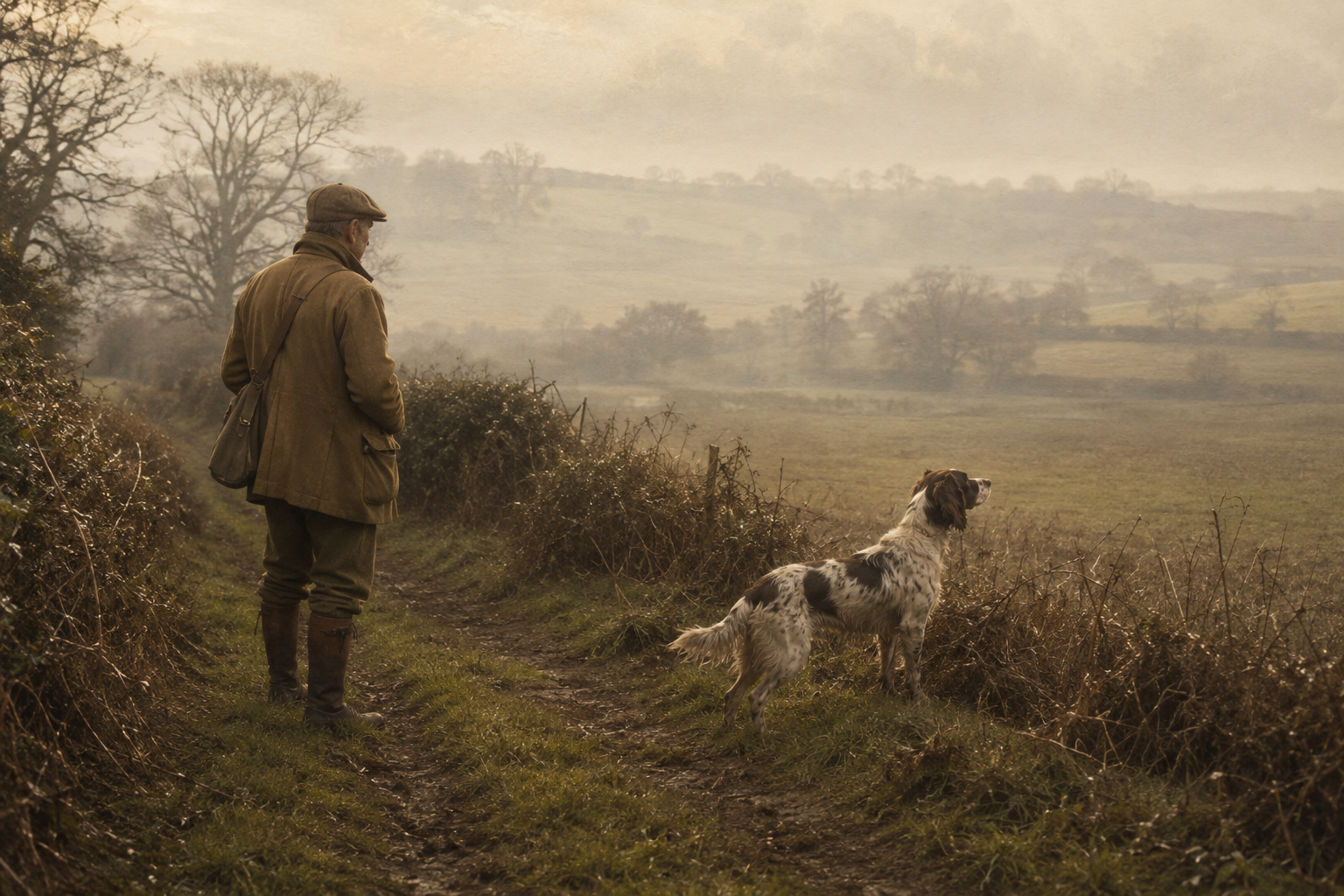
For thousands of years, a dog's behaviour carried information humans needed to work, hunt, guard, gather, move and understand the world around them.
A dog who stopped on scent knew something before we did.
A dog who lifted their head into the wind knew something before we did.
A dog who stood, stared, pointed, tracked, flushed, retrieved, guarded, warned, held back, moved ahead, hesitated or refused was not just performing a behaviour — they were changing what the human beside them knew about the world.
The dog's body was part of the human's perception. Their nose extended ours. Their hearing extended ours. Their night awareness, movement sensitivity, environmental reading and emotional responsiveness extended ours.
A dog at the edge of firelight, watching the tree line, working a hedgerow, gathering stock, holding a boundary, locating game or warning of approach was not decorative. It mattered in a plain, practical sense.
So the human had reason to notice — not in a sentimental way, and not because people in the past were magically better with dogs (many of those working relationships weren't kind at all), but because the job itself demanded a different kind of attention. If the dog indicated, the human looked. If the dog hesitated, the human wondered why. If the dog found scent, the human followed. If the dog refused ground, the human noticed. If the
dog guarded, warned, marked, tracked or returned with information, that behaviour had real, practical value to the partnership.
The dog wasn't only being trained. The dog was being consulted.
That, I think, is where the missed conversation begins. Not with a bark. Not with a lunge. Not with a dog labelled demanding, stubborn, reactive or attention-seeking by a wellmeaning but overwhelmed owner. It begins with a cultural shift — one that happened to all of us, gradually, without anyone deciding it on purpose.
Plenty of modern dogs still notice. They still indicate. They still hesitate, check, pause, return, look, wait, avoid, question and warn in ways that echo those older working relationships. What has changed is that most humans no longer need that information in the same practical way.
The dog's communication didn't disappear. Our need to listen did.
And once we stopped needing to listen, we became far more interested in whether the dog was listening to us.
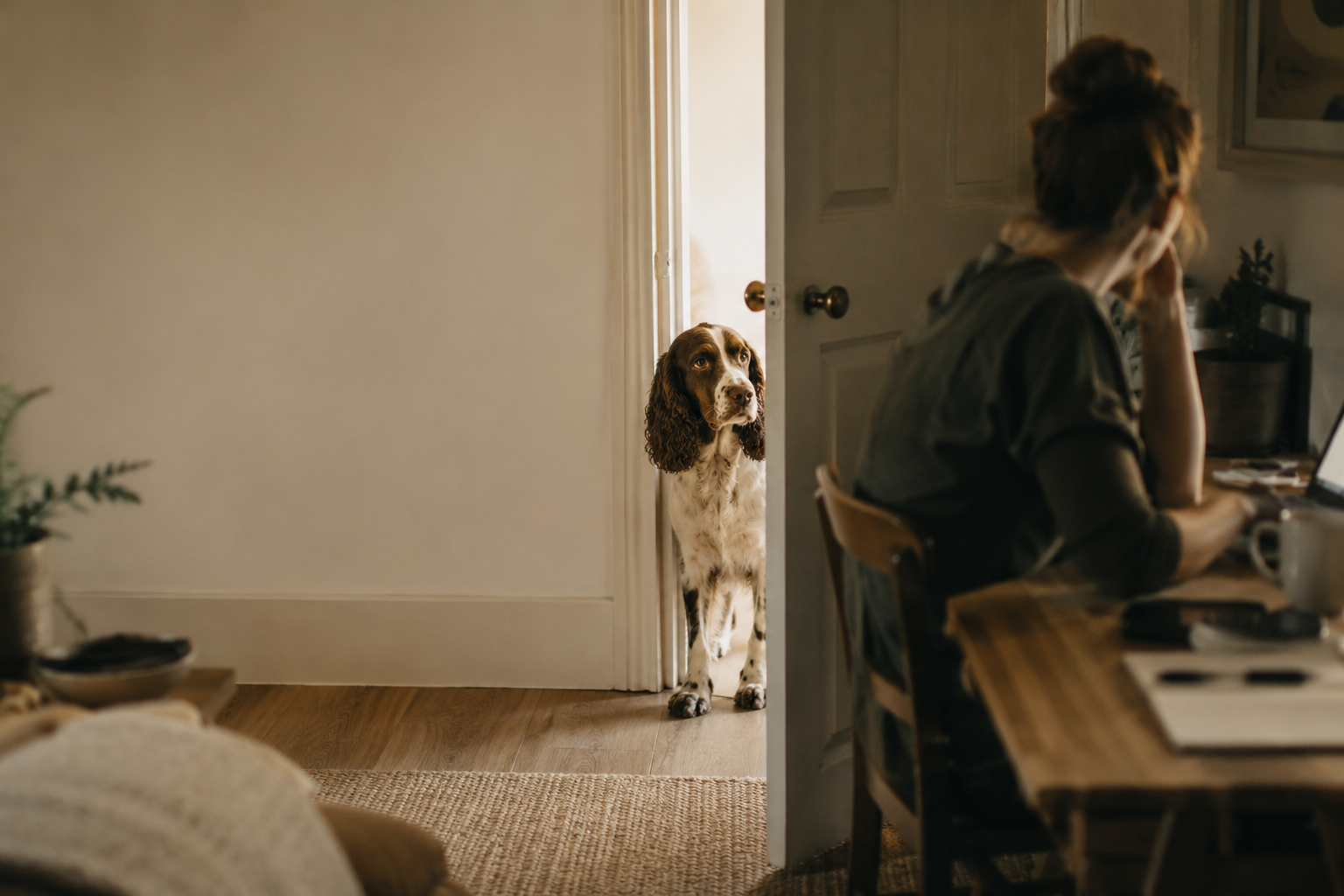
Ron at the office door
While I was writting this, Ron put his head around the office door and gazed at me.
It was half an hour past dinner time, and that dog is like the walking clock!
He didn't bark. He didn't scratch. He didn't whine, paw, leap or demand. He simply appeared around the doorway and looked at me, it was so subtle you couldn`t see his body, it was a dog peeking around a barrier — and if you've ever had a dog do something like this to you, you'll know exactly the look I mean.
Because of his behaviour and the time of day, I checked the clock and it was imediatly obvious what my anwer to this intervention was to be.
I answered by making his dinner.
There's nothing dramatic in that story, and that's exactly why it matters. Ron wasn't performing an obedience behaviour. He wasn't offering a trained check-in. He wasn't causing a problem or being difficult. He was using the smallest possible social opening available to him.
He'd noticed something about the world was slightly out of line and he new who to consult about it: dinner hadn't happened, dad makes dinner. He brought that information to me. I responded.
That's a conversation. Not a conversation in the human sense of words and grammar — dogs aren't speaking English with their bodies, and a look isn't automatically a sentence, a bark isn't always a request, a pause isn't always a deliberate message. But communication doesn't need to be language to be real.
A living creature can act in a way that affects another. The other can respond. The first can adjust. Over time, both learn what kind of exchange is possible. Ron never needed to get louder, because the quiet version worked.
Many dogs begin there. Quietly. A look. A pause. Small movement towards. Movement away. A glance at the door. Hesitation before stepping forward. A brief return to the human when something changes or a turn away.
A dog brings an object close. A dog looks from the thing they want to the person who controls access to it. A dog checks the human's body before approaching something uncertain.
A dog stops at the edge of a situation and waits for the human to become useful.
If you're an owner, you've probably lived a hundred of these moments without clocking a single one — they're easy to miss precisely because they aren't yet problems. They don't inconvenience us enough. They don't embarrass us in public. They don't demand an answer.
So, often, we don't answer.
Then later, when the dog becomes louder, we treat the louder behaviour as the beginning of the story.
But what if it isn't? What if the behaviour we eventually call "the problem" isn't always the dog's first attempt to reach us? What if, sometimes, it's the surviving strategy — the one that was left once the quieter ones stopped working?
Behaviour is not a sentence
I'm not suggesting every behaviour is communication. That would be far too simple, and it would do dogs and their owners a disservice.
Dogs do many things for many reasons. They explore. They react. They seek reinforcement. They avoid discomfort. They follow habit. They respond to pain. They chase movement. They repeat what has worked. They act from fear, frustration, arousal, fatigue, genetics, learning history and environmental pressure.
Not every look is a question. Not every bark is a message. Not every dog who jumps up is making a profound social statement.
But behaviour can still carry information. A dog doesn't need to be constructing a human-like message for their behaviour to matter inside an exchange — behaviour can carry information and influence another's attention or action without being languagelike or consciously formulated in a human sense.
So the better question, the one worth actually sitting with as a trainer or an owner, isn't "What sentence was the dog trying to say?" It's "Why did this happen now?"
Why did the dog look back at that moment?
Why did they pause there?
Why did they move away from that person but not this one?
Why did they bring the item close yesterday and run away with it today?
Why did they check in before the other dog appeared?
Why did they stop eating when the lead came out?
Why did they suddenly become still?
Why did they seek attention at that exact point in the evening?
Why now?
Sometimes the dog may not be asking for a cue at all. They may be checking the human's response to the situation. A dog who sees something ambiguous and looks back at the person may not be saying, in any literal sense, “What should I do?” or “How should I feel?” But functionally, that look may be part of gathering information: have you noticed, are we safe, are we going closer, are we moving away, does this matter?
That is why “why now?” matters more than translating the look. The question is what the dog was trying to involve the human in at that exact moment.
That single question changes the whole shape of the work. It pulls us away from treating behaviour as an isolated event and towards seeing the exchange around it — what happened before, what the dog attempted, what the human did, what changed afterwards. Did the dog soften, repeat, escalate, disengage, become clearer, become quieter, or try another strategy?
The meaning isn't held by the signal alone. It sits in the pattern — and reading the pattern, rather than just the moment, is a big part of what separates a good trainer from a great one.
When training replaces listening
This is where modern dog training can accidentally become too narrow.
Again — this is not an argument against training. Training is necessary. Cues are useful. Reinforcement matters. Boundaries matter. Safety matters. Clear structure matters, and no trainer worth their salt would tell a struggling client otherwise.
Training teaches dogs how to respond to us. Conversation teaches us how to respond to them. The problem was never training itself — the problem is when training quietly becomes a replacement for listening.
If training only teaches the dog to respond to the human, and never teaches the human to respond to the dog, something important gets lost along the way.
We end up asking for obedience before understanding.
We ask for calm before recognising conflict.
We ask for focus before asking what the dog has noticed.
We ask for recall before asking what coming back usually costs the dog.
We ask for delivery before asking what human hands predict.
We ask for quiet before asking why noise became useful in the first place.
We ask for tolerance before asking whether the dog ever had a safe way to say, "I need this to slow down."
The dog becomes a creature to manage rather than a social partner whose behaviour may be carrying information. Small as it sounds, that shift is a very modern problem.
Dogs shaped by life with humans — and many specifically bred to notice, respond and work with us — may now spend much of their life being told not to notice, not to respond and not to communicate unless asked: do not bark, do not pull, do not sniff too
long, do not stare, do not jump, do not paw, do not mouth, do not hesitate, do not growl, do not move away, do not get excited, do not seek attention, do not make choices.
Then we wonder why some dogs become noisy, frantic and insistent, while others go flat, inhibited and hard to read.
I'm not suggesting every one of those dogs is living inside a missed conversation — that would be overreaching. The real question is whether our default position, collectively, has shifted so far towards control that we've forgotten to ask what the dog was actually trying to involve us in.
This is especially important for trainers and behaviourists, because we rarely meet the dogs whose communication systems are working beautifully for their owners. People do not usually seek help because everything is easy.
By the time a dog arrives in front of us, we may not be seeing the beginning of the conversation. We may be seeing the version of the dog that adapted to the previous system.
The barking, grabbing, lunging, freezing, avoiding, stealing, guarding, pulling or shutting down may not be the first answer the dog ever offered. It may be the answer that survived.
That should make us more careful. The job is not only to name the behaviour. It is to ask what that behaviour has been doing for the dog, what earlier answer may once have existed, and what the human response taught the dog about whether that earlier answer was worth using.
The best handlers notice earlier
This is where working dogs still have something to teach the rest of us.
A person working with a dog can't get by on instructions alone. They have to read. The handler of a hunting dog watches for the dog's change of pace, head carriage, tail, tension, line, confidence and uncertainty.
The shepherd watches the dog's pressure, distance, eye, balance and effect on the stock.
The person whose dog guards a boundary has to know the difference between a useful alert, social noise, fear, frustration and a false alarm. The tracker has to trust that the dog may know something the human doesn't.
In those worlds, listening to the dog isn't indulgence. It's competence — full stop.
The best handlers I know don't fill the space with commands. They notice earlier. They read more accurately. They respond more appropriately. They know when to speak and when to stay quiet, and by the time they do give a cue, the dog is already inside the conversation with them, not waiting to be told what to do.
That matters just as much with companion dogs. The modern companion dog may not be working a hillside, hedgerow, boundary or track, but they're still navigating a complex world with senses, instincts and sensitivities we simply don't share. They still notice things before we do. They still respond to changes we miss. They still carry information in their bodies, whether or not anyone is trained to read it.
The tragedy was never that dogs stopped communicating. It is that many of us no longer know what their communication is for. So we reduce it to behaviour. Then we reduce behaviour to obedience. Then we reduce obedience to control. And finally, when the dog gets louder, we say they aren't listening.
Before a handler can become influential, they have to become useful.
That is not the same as being permissive, and it is not the same as being exciting. A useful human gives the dog information that helps them succeed. They help the dog find the retrieve, navigate the lead, create distance, understand the next step, recover from uncertainty, or stay inside the task rather than being pulled out of it.
If the handler's information is late, unclear, irrelevant or repeatedly expensive, the dog has good reason to use other information instead.
Cues are not neutral
One reason this matters is that cues are not always neutral.
A well-taught cue can be genuinely valuable to a dog — it can predict access, movement, release, food, work, play, continuation, success or relief.
That's part of why good training works so well the value value of the reward moves backward into the the cue itself.
But it also means a cue can quietly reinforce whatever came immediately before it. If the dog creeps, fixates, leans, stares, scans, crowds, braces, pulls or self-selects a line, and the handler then gives a cue the dog values, the dog may learn that the behaviour right before the cue is part of the route to success.
The handler thinks they've corrected the moment by giving an instruction. The dog experiences the instruction as confirmation.
A dog leans into the line, and then hears the release. A dog creeps forward, and then gets sent. A dog stares at the other dog, and then receives the cue that starts the next pattern. A dog pulls towards scent, and the walk continues. A dog crowds the hand, and the food appears. A dog barks, and the human finally becomes clear.
This isn't devious dog behaviour — it's practical learning. Dogs learn from sequence. They learn from timing. They learn from whatever opens the next door, the same as any of us would.
More commands don't always create clearer communication. Sometimes they add noise. Sometimes they arrive too late. Sometimes they confirm the very thing we thought we were interrupting. Sometimes the better intervention isn't another cue — it's a better answer to the moment that came before it.
Not louder handling. Earlier listening.
Voluntary check-ins and paid stares
Eye contact is another place where modern training can quietly become heavy-handed and i dont mean that in a nasty way.
Many puppies already look back on their own. They orient to people. They follow movement. They check faces. They return their attention to us. They notice whether we're available — long before anyone's taught them to.
Then, often, we take that naturally occurring social behaviour and turn it into a trained exercise. Food goes in the hand.
The eye contact gets marked.
The look gets rewarded.
Duration gets built.
It goes on cue.
We ask for it again and again, session after session.
There's nothing automatically wrong with teaching eye contact — in plenty of situations it's genuinely useful.
A dog who can orient back to the handler may be safer near roads, livestock, other dogs, distractions and uncertainty.
A dog with a clear, trained focus cue may find some environments much easier to navigate, and that's a real, practical win for both ends of the lead.
But it's worth being careful not to train over something that was already alive.
A voluntary check-in is not the same thing as a paid stare.
One is the dog opening a social exchange. The other can become a behaviour performed for an expected outcome. That's not a criticism of reinforcement — it's a reminder to look closely at what the behaviour was before we formalised it.
If we're not careful, we can take a naturally meaningful moment and quietly convert it into a transaction. The risk is that the look may begin to function less as an open social exchange and more as a behaviour performed for a predictable outcome. That might sound like a small distinction, but it isn't.
The original behaviour belonged to the relationship; the trained version may belong to the reward system instead.
None of this means reinforcement destroys relationship — that would be far too crude a reading, and reinforcement, used with good timing and respect for the dog's existing social behaviour, can support communication beautifully.
But it's worth asking, honestly, what we're building each time we reach for the treat pouch. Are we strengthening the dog's confidence that looking back opens a useful exchange with us? Or are we simply buying eye contact?
Suzanne Clothier's Auto Check-In work is genuinely relevant here and deserves clear credit. Her work helpfully distinguishes voluntary attention from cued attention, and
frames offered attention as part of relationship, not mere obedience. That voluntary moment may be the dog's way of opening a two-way exchange: not obedience, not a trick, not a performance, but a relationship moment.
My interest here goes wider than formal check-ins, though. I'm interested in the smaller conversations dogs attempt before anyone has trained a check-in — before the behaviour has become obvious, before the dog gets labelled as a problem.
The dog who glances back.
The dog who waits at the doorway.
The dog who looks at the object, then the person.
The dog who brings something close.
The dog who pauses before stepping forward. The dog who moves away during contact.
The dog who notices something and asks, in the only way available to them, whether the human noticed too.
That's not always a formal behaviour. Often it's just a small social opening, and the question — every time — is whether we answer it.
If a puppy's early check-ins get ignored for long enough, the handler may later find themselves working hard to train a behaviour that once existed freely, for nothing. For that dog, in that relationship, looking back may already have a history of not mattering. The dog didn't fail to offer attention. The human failed to answer it while it was still being offered for free.
The lead: attachment is not connection
The lead can create a similar problem, and it works in both directions.
Many dogs actually give more attention to their handler off lead than on lead — and if that surprises you, it shouldn't, once you think about why.
Off lead, connection has to be maintained socially. The dog has to notice where the human is, where they're going, whether they've changed pace, whether they've turned, whether they're still part of the same shared movement.
The human has to notice too — tracking the dog's line, speed, distance, attention, confidence, hesitation, interest and arousal, staying mentally present because the dog isn't physically attached to them.
On lead, the physical connection can quietly replace that social one.
The dog doesn't need to check where the human is, because the equipment guarantees proximity.
The human doesn't need to stay as attentive, because the equipment creates a feeling of safety and control.
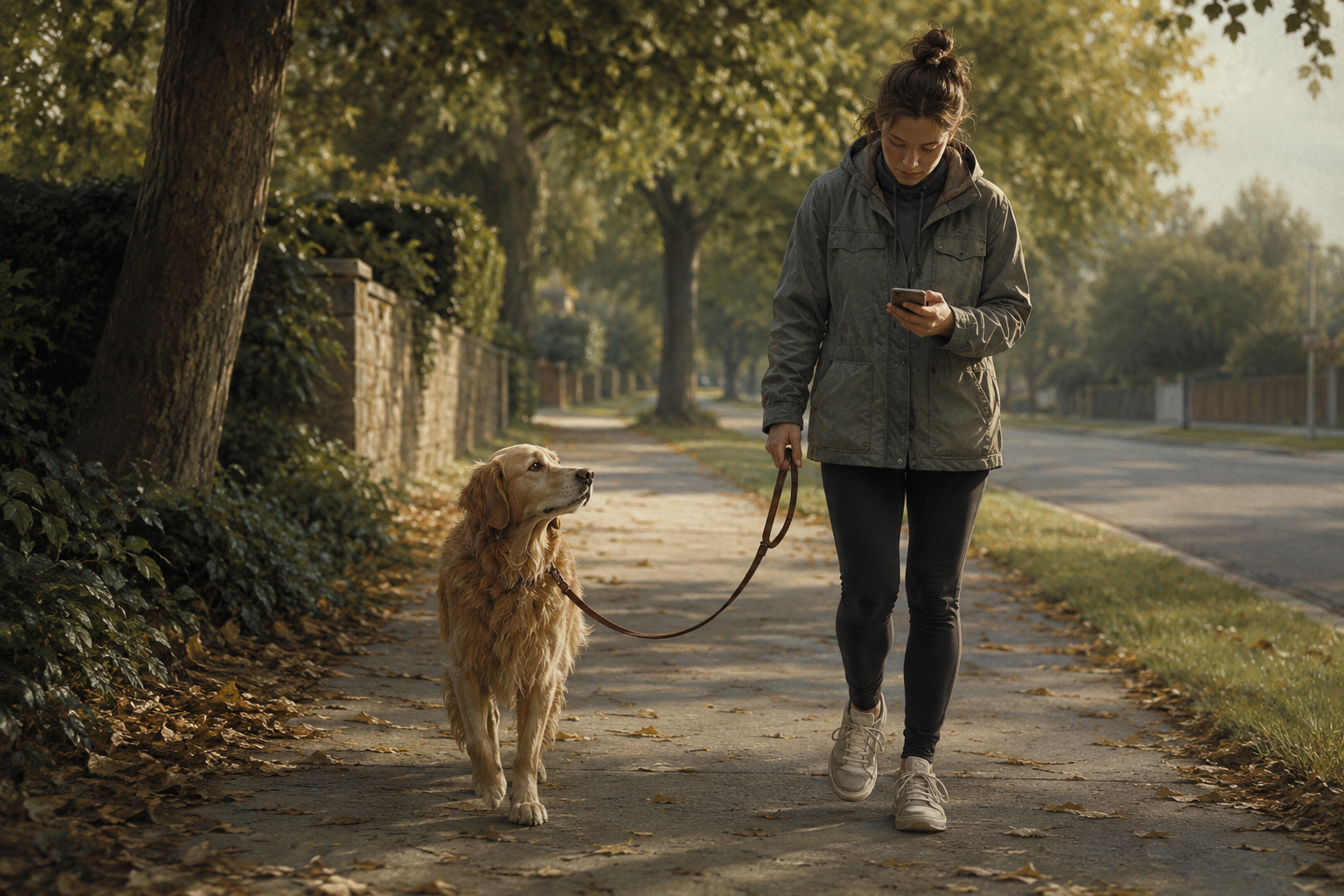
That feeling of safety changes the human's behaviour. Once the dog is clipped on, our attention often drifts elsewhere. We talk to another person. We check a phone. We drift into our own thoughts, walking the same route while mentally leaving the dog behind. The dog is beside us, but not really with us.
This is one of the most ordinary, everyday missed conversations in modern dog ownership — the lead keeps the dog physically connected while quietly letting the
human become socially absent. A phone doesn't just take your eyes off your dog. It takes your timing, your anticipation, your peripheral awareness and your responsiveness with it.
You stop noticing the small moments: the change of pace, the early scan, the hesitation, the glance back, the tightening body, the interest in something ahead, the uncertainty just before the reaction.
By the time you look up, the dog is often already louder — and then you respond to the behaviour you noticed, not the conversation you missed.
Even a long line can fall into this trap if it becomes a substitute for relationship rather than a safety net.
The result is a strange kind of togetherness: dog and human physically attached, but not necessarily socially connected. The dog pulls into the world. The human holds the line. Both are in contact. Neither is really listening. We use equipment to keep the dog with us, and quietly mistake attachment for connection.
The phone as a third participant
Phones have changed more than distraction on a walk — they've changed how attention moves through the whole home.
Phones rob dogs of human attention. The same phones can also pull children away from their parents, and that comparison is worth sitting with in the right direction.
In one case, the dog is trying to reach the human, but the phone has captured the human. In the other, the parent is trying to reach the child, but the phone has captured the child.
The direction is different, but the loss underneath it is similar: a living relationship competing against a device engineered to hold attention.
This is easiest to see with children. Many young children now get access to phones and tablets very early, and these devices aren't neutral objects. They're designed to hold attention: to pull the eyes back, to offer colour, sound, novelty, movement, reward and repetition, they actually leverage the seeking system, the same thing that most of us use to train our dogs.
Once a child is inside that loop, parents often find themselves competing for attention with something far more immediate and stimulating than ordinary human interaction.
The child is physically present, but their attention has been recruited elsewhere.
Dogs live inside these same human attention systems. The dog isn't holding the phone, but the household around them has still changed — human attention is more fragmented, social availability less predictable.
Quiet bids from the dog now compete with screens, alerts, messages, scrolling, and the strange stillness of a person whose body is in the room but whose mind has left it.
The phone has become a third participant in the household conversation, and often, it's the one getting the most attention.
Phones are not evil, and they're not the cause of every modern dog problem — that would be absurd. They are also useful, connecting and sometimes genuinely necessary.
But they're part of the new environment, and one of the clearest examples of how modern life quietly changes the conversation without anyone intending harm.
The dog is still in the room. The human is still in the room. But attention — the doorway to communication — has gone somewhere else.
Dogs are sensitive to availability. They notice eyes, body orientation, timing, movement, rhythm and response. If the human becomes harder to reach, the dog has to learn what still works.
Maybe they wait. Maybe they give up. Maybe they nudge, bark, paw, jump, steal, bring, stare or escalate.
Maybe they simply learn that the human is present but unavailable.
None of this should be overstated — a dog barking while you answer a message isn't automatically a tragedy, and using your phone around your dog isn't doing something wrong. But if a dog's quiet communication keeps meeting a human body whose attention is somewhere else, it's worth being curious about what the dog learns from that, over time.
The baby before words
Humans already know how to respond to non-verbal communication — we do it with babies before they can speak, every single day, without thinking twice about it which is good news because it means we are all capable of this skill.
That comparison does need care. Dogs aren't babies, and they shouldn't be infantilised — the point isn't that dogs and babies are the same, it's that humans already possess the skill of responding to communication before words exist.
A baby cries, turns away, stiffens, reaches, softens, looks, protests, settles, startles or seeks contact. Adults don't usually demand a complete, tidy signal before responding. They notice. They guess. They respond. They wait. They adjust. They learn the individual. They don't always get it right, but they understand that communication can begin before language and before obedience.
With dogs, people often set that same skill down. They wait for a trained behaviour before responding. They look for compliance before offering understanding. They worry that if they answer the dog, the dog will somehow end up controlling them.
But responding is not the same as obeying. When a baby cries and an adult picks them up, the adult isn't being trained by the baby in some absurd dominance exchange — they're participating in a communication loop. The same is true with dogs.
If a dog pauses during handling and the human pauses too, the human isn't being weak. If a dog looks back near something uncertain and the handler helps, the dog isn't being allowed to "win." If a dog growls and the human stops approaching, the human hasn't rewarded aggression in the simplistic way people often fear — they've recognised that the growl may be the only thing standing between discomfort and a bite.
A response isn't surrender. A response is information. It says: I noticed. And then, depending on the situation, it may go on to say: yes, no, not yet, this way, I will help, we need more distance, that isn't available, try this instead, I heard you and I will still keep everyone safe.
That's conversation with boundaries — and learning to hold both at once is, honestly, most of what good dog training actually is.
There is another piece here that matters: dog literacy is learned.
It is not magic, and it is not guaranteed by loving dogs. Plenty of caring owners miss early communication because they have never been taught to see the whole sequence. They may notice the bark but not the glance before it, the lunge but not the earlier stillness, the refusal but not the repeated pattern in which human hands predict loss.
Reading dogs well is not simply knowing a list of body-language signs. It is learning to see context, timing, sequence, human response, outcome, history and alternative explanations together.
That matters because this is not a blame argument. If humans have stopped listening well, it is often because the modern world has given them fewer reasons, fewer models and fewer opportunities to practise listening.
There is also an opposite mistake worth naming.
Sometimes people do not miss too little; they notice too much too quickly.
A dog licks their lips, yawns, looks away, sniffs the ground or pauses, and the human immediately assigns the meaning they read in a book or heard on a course. Stress. Anxiety. Avoidance. Conflict. Displacement.
Sometimes that interpretation may be right. Sometimes it may not be.
A lip lick does not always mean stress. A yawn does not always mean anxiety. A pause does not always mean refusal. A look away does not always mean the dog is asking for space. The behaviour matters, but it does not carry its full meaning alone.
The danger is that we stop consulting the dog and start consulting our own label. We decide what the dog is “saying” before we have read the context, the timing, the history, the human response and what changed afterwards.
Good dog literacy is not automatic translation. It is a slower kind of curiosity.
What the science supports
There is good scientific reason to take this seriously, though the science needs to be handled carefully and honestly, without overreaching, but those of us with dog experience already know these things and don`t really need sciences confirmation, but its there.
Research supports the idea that dogs produce human-directed communicative behaviours in some contexts.
Dogs have been shown to use gaze and gaze alternation around inaccessible food and unsolvable tasks.
Some of those behaviours change depending on whether the human is attentive.
Dogs may also look to humans in ambiguous situations and use the human's reaction as one source of information about what to do next.
That doesn't mean dogs communicate like people. It doesn't mean every everyday behaviour is a deliberate request. It doesn't mean we can translate dogs into neat human sentences. But it does mean the dog is not merely a passive recipient of our cues — dogs don't only respond to human information, they also offer information to us.
The evidence also supports something simple and important for anyone working through a hard training phase: dogs learn from whether their behaviour works. A human-directed behaviour can grow stronger when it produces a useful outcome, and weaker when it doesn't.
That's not controversial. That's just learning.
But placed inside the human-dog relationship, that raises a serious possibility worth sitting with. If a dog's quieter attempts to involve the human repeatedly change nothing,
those quieter attempts may become less useful and start to fade.
If louder behaviour changes the world, louder behaviour may grow.
If stillness keeps the dog safe, stillness may grow.
If checking in never makes the handler relevant, checking in may fade.
If bringing things close predicts loss, distance may become the smarter strategy.
If growling gets punished, the dog may lose one of the clearest warning signals they had left.
This isn't a universal law, and it isn't the explanation for all problem behaviour — it isn't yet directly proven as one single, complete causal pathway. It's a careful hypothesis about some dogs, in some contexts, with some histories.
But it's plausible enough that it should stop us dismissing behaviour as simply stubborn, naughty, dramatic, attention-seeking or disobedient without first asking what that dog has learned about being heard.
Attention is the doorway
The phrase "attention-seeking" is a good example of the problem, and if you've worked with dogs for any length of time, you've probably heard it used as if it explains everything.
"He's just attention-seeking."
That might be true, but it only tells us what the behaviour does to the human — it gets attention. It doesn't tell us why attention was needed in the first place.
A dog may seek attention because they want access to the garden, because they're tired, because the routine has changed, because something outside has unsettled them, because they need help, because they're frustrated, because they've learned that humans only respond at a certain volume, or simply because social contact matters to them, the same as it does to us.
Attention is not a trivial thing to ask for. For a dog living in a human-controlled world, attention is often the doorway to everything else. The human controls doors, food, leads, movement, greetings, distance, access, restraint, transport, veterinary care, grooming, play, rest, release and safety.
If the dog needs any of that to change, they usually need the human's attention first.
Attention-seeking isn't the problem. Attention is the doorway to communication.
So the better question isn't "How do I stop this dog seeking attention?" It's "Why does this dog need my attention right now?"
That doesn't mean reinforcing every behaviour, letting the dog dictate the household, or turning barking, pawing, jumping and grabbing into the main route to a human response. It means staying interested in the earlier version of the ask.
What did the dog do before they barked?
What happened before they jumped?
Did they already look?
Did they move closer?
Did they wait?
Did they try the quiet route — and if they did, did it actually work?
Sometimes the right answer is to give access. Sometimes it's to create distance. Sometimes it's to help. Sometimes it's to acknowledge the ask and hold a boundary anyway. Sometimes it's to teach a safer, clearer way for the dog to ask next time. A response is not the same as giving in. A response is the human choosing to become part of the exchange.
One response may help but a pattern of responses teaches.
Dogs learn from repeated loops, also so do we, or at least we should:
I looked back and the handler helped; I paused and the pressure paused; I brought the item closer and value did not disappear; I disengaged and distance became available; I checked in and the human became useful.
That is how quiet communication remains worth using. Not because the dog gets everything they want, but because the dog learns that earlier, safer, clearer behaviour can change the exchange.
Dogs who stop asking
This becomes especially important when dogs appear to stop asking altogether.
Owners often tell trainers, "There was no warning." Sometimes they're right — some behaviour is genuinely fast, compressed or hard to predict. Pain, startle, sleep, predatory behaviour, neurological issues, restraint, sudden pressure and environmental overwhelm can all produce behaviour that seems to arrive with little visible warning.
So we should never claim dogs always warn clearly, because they don't.
But we should also be careful not to treat "no warning" as the end of the conversation.
Sometimes the earlier signs were there but missed.
Sometimes they were too subtle.
Sometimes the dog was prevented from using them.
Sometimes moving away didn't work because the human followed.
Sometimes pausing didn't work because the human pushed on anyway.
Sometimes growling was punished.
Sometimes checking in never helped.
Sometimes bringing the object close always meant losing it.
Sometimes the lower rungs on the ladder simply weren't available, safe, or useful for that dog, in that home.
The absence of signalling may itself be something a dog learns — not always, but sometimes, and if it's even sometimes true, then our job isn't only to stop the final behaviour. It's to ask what earlier behaviour could become useful again.
That applies well beyond bites, growls and dramatic cases. It applies to the dog who no longer brings the retrieve close, because coming in has started to predict loss. The dog who no longer checks back, because checking back has never once changed the approach of the oncoming dog.
The dog who no longer pauses, because pausing has always been pushed through anyway.
The dog who no longer offers small greetings, because it's always the big greetings humans actually notice.
There is another version of the same problem that can be harder to spot: the dog who becomes quieter.
Quiet can be healthy. A dog may be quieter because they are safer, clearer, better understood and better regulated. But quiet can also mean inhibition, suppression, exhaustion or loss of options.
So the question is not simply, “Did the behaviour stop?”
The better question is whether the dog has more flexible behaviour available.
Can they move towards and away?
Can they seek help?
Can they pause and re-engage?
Can they rest without disappearing?
Can they recover after pressure?
Recovery expands behaviour. Suppression narrows it.
None of this should tip into blame. Most owners have never been taught to see these moments. Many are following poor advice, many are stressed, embarrassed or overwhelmed, and many are working with signals that are genuinely fast and hard to read.
But the absence of subtle communication should make us curious, not certain.
It should change the question we ask: not only “How do we stop the final behaviour?” but “What would this dog need to learn for an earlier behaviour to matter again?”
A small practical invitation
Here's the practical shift, and it's small but it can genuinely change how a walk, or an evening, feels.
For one day, notice every time your dog looks at you without being cued. Don't rush to decide what it means — just ask,
"Why now?"
Why now, in this room?
now, on this walk?
Why now, with that person approaching?
Why now, before that behaviour happened?
Why now, after that sound?
Why now, when I moved my hand?
Why now, when the lead tightened?
Then respond lightly, and watch what changes. Maybe you pause. Maybe you soften your body. Maybe you open the door. Maybe you create distance. Maybe you help the dog disengage. Maybe you acknowledge the ask and carry on. Maybe you make the next step clearer. Maybe you realise the dog was not asking for anything at all — and that's fine too.
If you ever see me on a walk, when Ron does it to me and ive got nothing to offer I often just blow a raspberry at him, that's my acknowledgment without much consequence!
The point isn't to invent meanings that aren't there. The point is to become interested again, because interest is where listening begins — and it costs nothing to try.
When the whisper still works
Ron put his head around the door because dinner was late.
That moment was ordinary. Domestic. Almost laughably small. But it contained the whole thing.
A dog noticed. A dog involved a human. A human responded. The dog didn't need to shout, because the whisper still worked.
Perhaps that is what many modern dogs risk losing. Not language. Not love. Not even training. They may lose the usefulness of quiet communication in a world where humans no longer depend on what dogs know.
For most of our shared history, dogs gave humans information that mattered — scent, movement, danger, prey, stock, boundaries, uncertainty, opportunity, environmental change. Their bodies changed what we knew about the world.
Now, many dogs still offer that information, but plenty of us no longer know what to do with it. We ask for obedience before curiosity.
We reach for cues before context.
We train attention while missing the attention already freely given.
We hold the lead and mistake physical attachment for connection.
We sit in the same room while the phone receives the conversation.
We wait for the bark and miss the look.
None of this means training is wrong. It means training isn't enough if the conversation only ever travels one way.
Before we ask how to make dogs listen, maybe we should ask when we stopped listening to them. And maybe the first step back isn't a new technique at all. Maybe it's simply this: when the dog looks, pause long enough to wonder why.
Evidence note
This article isn't claiming that science has proven the full missed-conversation model.
The stronger evidence supports the foundations: dogs can produce human-directed communicative behaviours in some contexts; dogs use gaze and gaze alternation around inaccessible or unsolvable tasks; some dog behaviours change depending on whether the human is attentive; dogs may look to humans in ambiguous situations and use human reactions as one source of information; and dogs learn from whether behaviour works.
Human dog-reading is also uneven and learned. Research on human interpretation of dog emotion and behaviour suggests that experience, context and cultural exposure influence what people see and miss.
Relevant research areas include work on gaze alternation and inaccessible tasks, including Savalli et al., Marshall-Pescini et al. and Ohkita et al.; social referencing work including Merola et al., Duranton et al. and Fugazza et al.; and response-contingency work such as Bentosela et al. and Elgier et al.
The wider claim — that repeatedly missed, ineffective or punished low-intensity bids may change some dogs' future communication strategies, including reduced signalling, escalation or behaviour later labelled as a problem — remains a careful clinical hypothesis. It is consistent with learning theory and professional observation, but it should not be presented as a proven longitudinal causal pathway.